
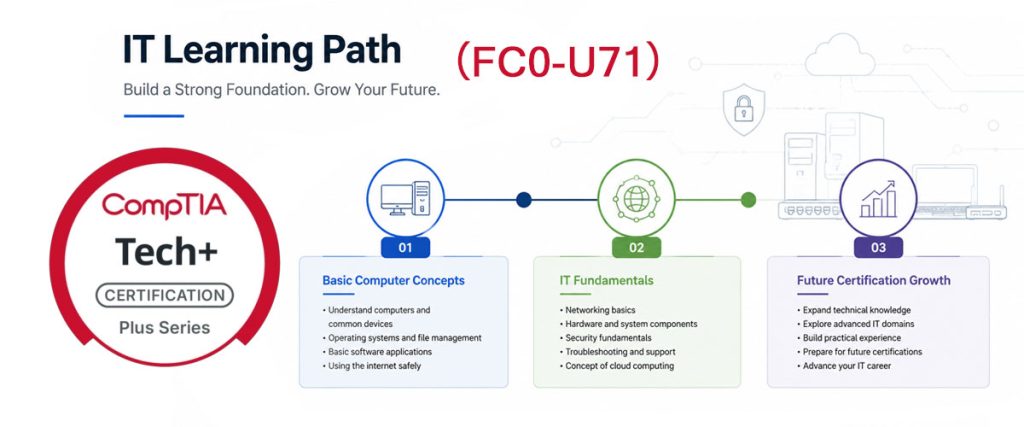
Starting your first IT certification is often less about choosing the hardest exam and more about choosing the right starting point. CompTIA Tech+ FC0-U71 can be useful, but it is not designed for everyone entering technology.
Tech+ Is Not About Becoming an IT Professional Overnight
When beginners discover CompTIA Tech+ FC0-U71, the first question is usually whether it can help them get an IT job. That is understandable, but it is also where expectations can become unrealistic.
Tech+ is not a replacement for experience-based certifications like CompTIA A+, and it is not meant to prove that someone is ready to handle enterprise support issues. Its purpose is much simpler: helping people understand the basic language and concepts of technology before moving into more specialized areas.
I think this distinction matters because many certification decisions are made backward. People start by looking at the certification name, then assume the credential will create the career opportunity. A better approach is to look at your current knowledge and ask what problem the certification is solving.
For someone who has never studied technology formally, the challenge is often not the difficulty of advanced topics. The challenge is understanding what those topics mean.
Terms like operating systems, networking, authentication, cloud services, virtualization, and security controls can feel disconnected when they are completely new. Tech+ provides a structured introduction to those areas so future learning becomes easier to organize.
A good analogy is learning the layout of a city before driving through it. Knowing the streets does not make you an experienced driver, but it prevents you from getting lost when you start traveling.
That is where FC0-U71 fits.
It creates awareness. It builds vocabulary. It helps beginners understand how different technology areas connect.
What it does not do is replace hands-on practice, workplace experience, or deeper technical training.
The Question Beginners Should Ask Before Choosing Tech+
The biggest mistake with entry-level certifications is asking:
“Is this certification worth it?”
That question is too broad.
A better question is:
“Is this certification the right next step for where I am today?”
A beginner with no technical background and someone who has repaired computers for years are not solving the same problem.
For the first person, the challenge is building a foundation. For the second person, the challenge may be developing professional troubleshooting skills.
The certification path should match the starting point.
When Tech+ Makes Sense
Tech+ can be a practical choice for people who are completely new to IT.
Examples include:
- Someone changing careers and exploring technology for the first time.
- A student who wants an introduction before committing to a technical program.
- A professional working with technology but lacking formal IT knowledge.
- Someone who feels overwhelmed by certifications such as A+ or Network+.
For these learners, Tech+ reduces the initial learning curve.
Instead of immediately dealing with detailed hardware troubleshooting, networking configurations, or security scenarios, they first develop an understanding of the bigger picture.
That foundation can make later certifications less intimidating.
When Skipping Tech+ May Be the Better Choice
Tech+ is not automatically the best first certification.
Someone who already understands computer components, installs operating systems, manages home networks, or regularly solves technical problems may find more value in starting with A+.
The reason is simple: they may already have the foundation that Tech+ is designed to provide.
A+ focuses more directly on practical IT support skills. It covers areas that connect more closely with entry-level technical roles, including hardware, operating systems, troubleshooting, and operational procedures.
The mistake is choosing Tech+ because it sounds easier or choosing A+ because it is more recognized.
The better choice depends on your current ability.
What FC0-U71 Actually Teaches You (And What It Does Not)
CompTIA Tech+ FC0-U71 introduces several technology areas that appear throughout the IT industry.
The exam covers foundational knowledge related to:
- Computing concepts
- Hardware basics
- Software and applications
- Operating systems
- Networking fundamentals
- Security awareness
- Data concepts
However, beginners should understand the level of knowledge expected.
Tech+ helps you understand what these technologies are and why they matter. It does not train you to perform advanced administration or troubleshooting tasks.
For example, learning about authentication helps you understand how systems verify users. It does not mean you are ready to manage identity systems in a company environment.
Learning networking concepts helps you understand how devices communicate. It does not mean you can immediately design and maintain a corporate network.
That difference is important because realistic expectations lead to better learning decisions.
A certification is a structured learning milestone, not a substitute for experience.
The Problem With Studying Tech+ Like a Traditional Exam
One thing I would avoid when preparing for FC0-U71 is treating every topic as a definition list.
Technology is not a collection of independent terms.
A computer is not just hardware. It is hardware running software, connected to networks, protected by security controls, and used by people.
When studying, try to understand the relationships.
For example:
A user logs into a computer.
That simple action involves:
- An account identity.
- Authentication.
- Permissions.
- Operating system functions.
- Security policies.
Understanding that chain creates stronger knowledge than memorizing individual definitions.
The same applies to networking.
Knowing that a router connects networks is useful. Understanding why devices need communication paths and what happens when those paths fail is much more valuable.
The goal of FC0-U71 preparation should be building a mental model of technology.
Once the concepts connect, remembering exam details becomes much easier.
Tech+ vs A+: Choosing Based on Your Background
The comparison between CompTIA Tech+ and A+ is common because both certifications attract beginners. However, they serve different audiences.
| Your Situation | Better Starting Point |
|---|---|
| Completely new to technology | CompTIA Tech+ |
| Little IT knowledge but want a foundation | CompTIA Tech+ |
| Comfortable troubleshooting computers | CompTIA A+ |
| Looking specifically for help desk skills | CompTIA A+ |
| Planning a longer IT certification path | Depends on your experience |
If your goal is understanding technology before moving forward, Tech+ may be the better starting point.
If your goal is developing practical support skills, A+ may provide a more direct path.
Neither certification replaces the other. They simply begin from different places.
A common mistake is comparing them only by difficulty. The more useful comparison is purpose.
How I Would Approach FC0-U71 Preparation in 2026
If I were preparing for Tech+ today, I would focus less on finishing study materials quickly and more on building useful understanding.
Start With Core Concepts
Before worrying about practice exams, understand the basics:
- How computers process information.
- How operating systems manage resources.
- How networks allow communication.
- Why organizations need security controls.
These ideas appear repeatedly throughout IT.
Use Practice Questions Properly
Practice questions are helpful when they show where your understanding is weak.
They become less effective when they are treated as answer memorization exercises.
When you miss a question, focus on why the correct answer is correct.
Ask:
- What concept is this testing?
- Where would this appear in a real environment?
- How does it connect with other technology areas?
That approach creates knowledge that lasts beyond the exam.
Candidates who want additional exam practice resources can evaluate third-party preparation materials such as Leads4Pass FC0-U71 resources. These materials should be used as a supplement to official exam objectives and real understanding rather than as a replacement for learning.
Add Small Hands-On Activities
Even simple experiments improve learning.
You do not need an expensive home lab.
You can:
- Explore system settings on your computer.
- Install a virtual machine.
- Learn basic command-line tools.
- Practice creating user accounts.
- Review basic network settings.
Hands-on exposure gives meaning to concepts that otherwise remain theoretical.
Jay’s Perspective: Where Tech+ Fits in an IT Career Path
After following IT certification discussions and beginner learning paths, I believe the biggest challenge is not finding information. There is more training content available today than ever before.
The difficult part is knowing what information matters at your current stage.
Tech+ has a specific role. It helps beginners build enough understanding to continue learning with confidence.
It is not a career shortcut.
It is not a replacement for technical experience.
It is a starting framework.
For someone who feels lost when reading about IT careers, that framework can be valuable because it turns a confusing field into a structured learning path.
The best certification is not always the most advanced one. It is the one that helps you make meaningful progress from where you currently are.
Conclusion: What CompTIA Tech+ FC0-U71 Can and Cannot Do
CompTIA Tech+ FC0-U71 is best viewed as a foundation certification.
It can help beginners understand technology concepts, prepare for future certifications, and develop confidence when entering IT.
However, it will not create job-ready technical skills by itself.
The candidates who benefit most are those who understand its purpose. They use Tech+ as the first layer of a larger learning journey, combining certification knowledge with practice and continued exploration.
Before choosing FC0-U71, ask yourself one question:
“Do I need a technical credential, or do I need a stronger foundation before moving forward?”
For many beginners, that answer determines whether Tech+ is the right first step.
